
Forever Ago · Systems · Guide
Forever Ago Gameplay — Road Trip Loop, Camera and Pacing
Forever Ago gameplay explained: the explore-and-photograph loop, Alfred's instant camera puzzles, how conversation carries the story, and the pacing described.
By the Game Atlas team · Updated 2026-10-11
On this page (11)
- The Explore-and-Photograph Loop
- The Camera as a Puzzle Tool
- Conversation, Characters and Two Timelines
- Failure, Restarting and What There Is to Lose
- Difficulty and Pacing
- What Is Not Documented Yet
- What is the core loop in Forever Ago?
- What does the camera do beyond taking pictures?
- Is there combat or any way to lose?
- Is there a difficulty setting?
- How does the game handle pacing?
Forever Ago gameplay is a road trip loop rather than a combat loop. You arrive somewhere new as Alfred, walk the environment, examine and interact with the objects around you, talk to whoever is there, and take photographs with his instant camera. The store page describes exactly that sequence: travel to beautiful places, capture memories with your camera, meet interesting characters and make new friends, in a single-player road trip adventure.
That makes the loop closer to a reading habit than a skill curve. What you get out of each stop is context, and what you spend it on is understanding the story. The sections below break down each part, then look at what the store page does and does not say about failure and pacing.
The Explore-and-Photograph Loop
The repeatable unit of play is short. You arrive at a location, orient yourself, and start looking. The store page names examining and interacting with objects as the way you learn about your surroundings and the people living there, so the objects are the content rather than decoration.
- Arrive at a new place and walk its perimeter before touching anything.
- Examine and interact with the objects that stand out.
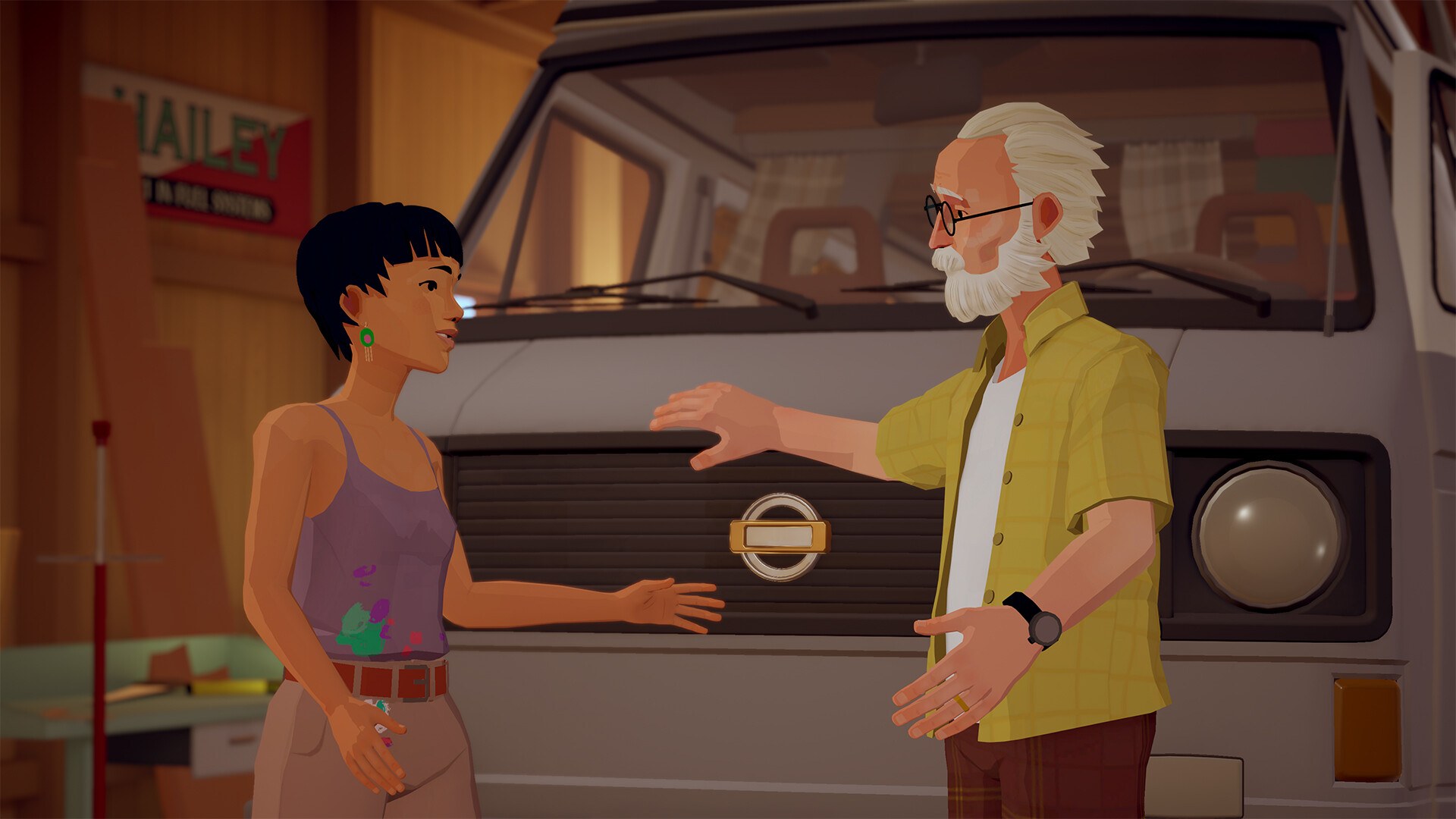
- Talk to every character present, since dialogue carries the story.
- Frame and take photographs of whatever you want to keep or need for a puzzle.
- Move on once the scene has given up its context.
The Camera as a Puzzle Tool
The camera is the only system the store page describes as doing two jobs at once. It documents your journey, and it also solves small environmental puzzles. Because the puzzles are described as small and environmental, they read as things local to the scene in front of you rather than as a separate logic mode. Our camera page goes deeper on the tool itself.
Practically, that changes how you scan a room. Instead of only asking whether an object is interactable, you also ask whether the scene is composed for a photograph. When a shot looks deliberately arranged, that is the cue the store page is pointing at.
Conversation, Characters and Two Timelines
The narrative arrives from two directions at once. In the present, Alfred meets characters whose stories, beliefs and struggles you learn about along the way, and the store page notes those characters are brought to life by renowned voice actors. In parallel, you play through a lifetime of love as Alfred with his sweetheart Audrey, a love the store page describes as transcending time.
That second strand is why the pacing can shift without a mechanical change. The road trip supplies distance and place; the Audrey sequences supply memory. A player who only chases the next location will still see the story, but will miss the texture that the examinable objects provide.
| Loop element | What the store page says | What the player gets |
|---|---|---|
| Travel | Journey north to beautiful places, from forest trails to desert barrens | A new scene to read |
| Examine | Interact with objects to learn about your surroundings and the people there | Context and world detail |
| Talk | Meet interesting characters and make new friends | The story's main channel |
| Photograph | Document the journey and solve small environmental puzzles | Progress through local puzzles |
| Audrey sequences | A lifetime of love that transcends time | The emotional counterweight |
Failure, Restarting and What There Is to Lose
The store page documents no fail state. There is no combat system, no health or stamina resource and no described penalty for taking your time, which means there is nothing to restart in the conventional sense. The only thing you can genuinely lose is content: a conversation you walked past, or an object you never examined.
For that reason the cost of playing quickly is invisible. Nothing pops up to tell you that you missed a scene, and no score screen compares you to anyone else. The store page does not describe a chapter select, a save system or a replay mode either, so how you revisit content is not documented yet.
Difficulty and Pacing
Difficulty, as the store page presents it, is not a setting. No easy, normal or hard option is listed. What the page does list under accessibility-style features is camera comfort, custom volume controls, playable without timed input, subtitle options, stereo sound and surround sound. The presence of playable without timed input is the closest thing to a statement about pressure: the design does not lean on reaction time.
Pacing instead comes from environment contrast and from the alternation between the road trip and the Audrey strand. Serene forest trails and sweltering desert barrens are named as the two ends of the range, and the store page treats the variety of places as a selling point in itself.
What Is Not Documented Yet
A systems page would normally close with numbers. This one cannot, honestly. The store page and official site do not state how many chapters or locations the game has, how long a playthrough lasts, whether there are collectibles with completion tracking, or how many endings exist. The achievements page covers what the store does publish, which is the achievement count and ten names. For the systems in order as a new player, the beginner guide is the better starting point.
FAQ
1.What is the core loop in Forever Ago?
Arrive somewhere new, explore on foot, examine and interact with objects, talk to the characters you meet, and photograph what you find. The store page lists all four verbs: travel to places, examine objects, meet characters and capture memories with the camera.
2.What does the camera do beyond taking pictures?
It solves small environmental puzzles as well as documenting the journey. The store page states that you take pictures with Alfred's instant camera to document your journey and solve small environmental puzzles.
3.Is there combat or any way to lose?
Not documented. The store page describes exploration, examining objects, conversation and camera puzzles, and lists no combat system, no health resource and no fail state.
4.Is there a difficulty setting?
Not documented yet. The store page lists no difficulty options; the closest categories are camera comfort, custom volume controls, playable without timed input, subtitle options, stereo sound and surround sound.
5.How does the game handle pacing?
Through contrast of environments rather than a score or timer. The store page points to serene forest trails at one end and dusty barrens sweltering in the desert sun at the other, with the story told through conversations and examinable objects.
More in Systems
More systems pages in Forever Ago.
References
- Forever Ago on Steam
- Forever Ago app details (Steam Web API)
- Forever Ago official site
- Forever Ago Steam Community
Facts on this page are compiled from the references above. Items marked "to confirm" are single-source and not yet verified.