
Hex Reverse · Start Here · Guide
Hex Reverse Beginner Guide — First Hour
A Hex Reverse beginner guide to the 19-space hex battlefield: how cards flip on touching edge values, how a run builds its deck, and the first-hour fixes.
By the Game Atlas team · Updated 2026-10-09
On this page (11)
Hex Reverse is a roguelike deckbuilding card game played on a hexagonal battlefield, released for Windows on October 7, 2026 by developer and publisher IsaoWorks. If you are just starting, the one idea that matters most is that the game rewards position over raw card strength: every card carries six values, one for each side, and a battle is decided by whether your value beats the opponent's value on the edge that actually touches when the cards sit next to each other.
What Hex Reverse Is
Hex Reverse is a single-player game. The store page lists it under Casual, Indie and Free To Play, supports English and Japanese, and ships with 27 Steam achievements. There is no multiplayer, no controller support and no Steam Workshop. The table below collects the facts most new players check before their first run.
| Item | Hex Reverse |
|---|---|
| Release date | October 7, 2026 |
| Developer / Publisher | IsaoWorks |
| Price | Free To Play |
| Platform | Windows (Steam) |
| Players | Single-player |
| Achievements | 27 |
| Languages | English, Japanese |
| Demo | None |
Your First Hour
The most practical first step is about timing rather than skill. The store page states that Hex Reverse will be available for free during the first 30 days after release, and that adding the game to your Steam library during that free period keeps permanent access even after it becomes a paid title. Add it to your library while it is free, then use the opening battles to learn how edge comparisons read on a crowded board instead of trying to win quickly.
For the first hour, treat every placement as a reading exercise. Look at which edges of your card will touch which edges of the opponent's, and pick the square that gives you the most winning comparisons rather than the biggest numbers.

How a Battle Plays Out
Battles take place on a field of 19 hexagonal spaces, and you and your opponent take turns placing cards. Each card has six values, one for each side. When you place a card next to an opponent's card, the values on the touching edges are compared, and if your value is higher the opposing card flips to your side. A single well-placed card can therefore turn several neighbours at once, which is why the store page tells you to read the board and use each card's strengths to take as much territory as possible.
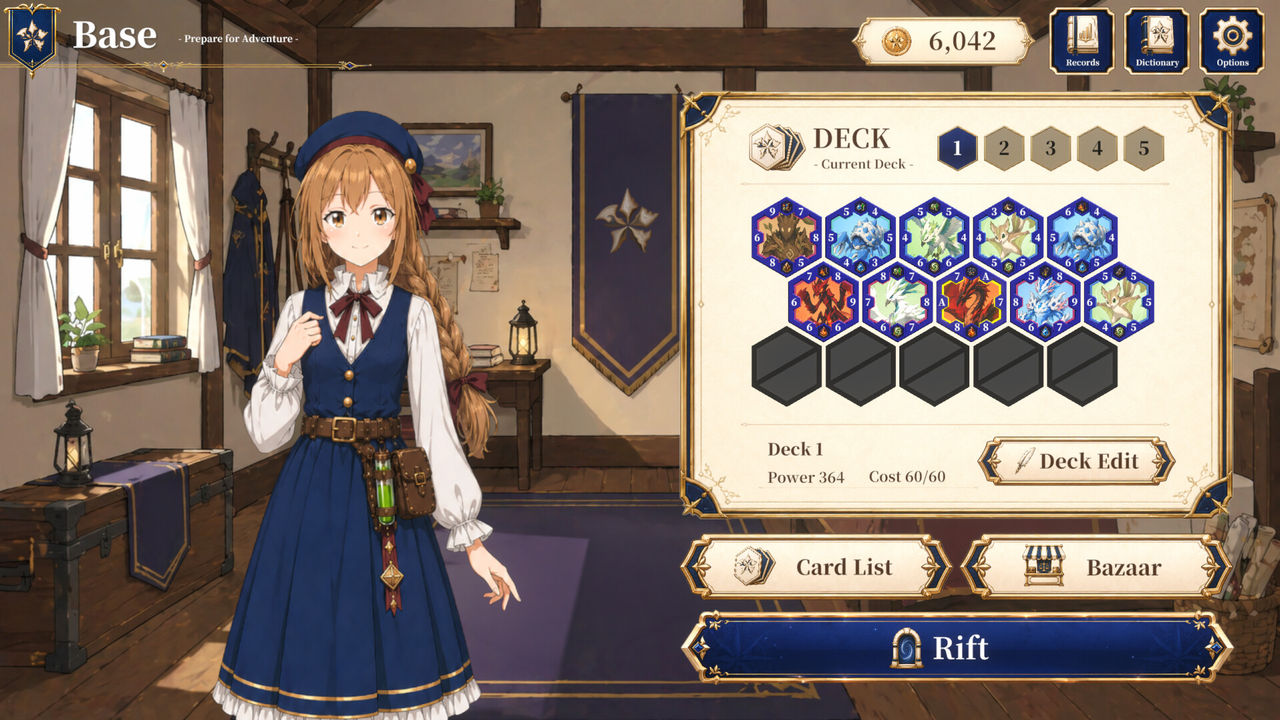
Building the Deck During a Run
Each run is a series of battles. After you win a battle, you choose one card from a selection taken from your opponent's deck, and that card is added directly to your current run deck for the battles ahead, so every pick changes the shape of the deck as the run progresses. The store page also describes skills you activate with SP to strengthen cards, change their element, weaken opponents, draw additional cards or alter the flow of battle, plus special rules and unique field conditions that force you to rethink familiar plans. The cards page covers the value and flip rules in more detail.
Mistakes That Stall a New Run
- Placing cards for their big numbers instead of for the edges they will actually touch.
- Dropping a card where only one weak edge connects, when a nearby square would connect two.
- Spending SP on a small effect when a card flip would have done more.
- Ignoring that your own cards can be flipped by the opponent on the following turn.
- Treating each card pick as a minor choice, when it reshapes the whole run deck.
Where to Go Next
If you want the mechanics rather than the orientation, the gameplay page walks the full loop, while the release date page covers launch timing and pricing. Check the system requirements before you install, look at the achievements list if you plan to complete it, and read the features overview or the platforms page for the rest.
FAQ
1.Is Hex Reverse free to play?
Yes. It is a Free To Play listing, and the store page states the game is free during the first 30 days after release. If you add it to your Steam library in that window you keep permanent access even after it becomes a paid title.
2.What kind of game is Hex Reverse?
It is a roguelike deckbuilding card game played on a hexagonal battlefield. You place cards on a board of 19 hexagonal spaces, compare the values on touching edges, and flip enemy cards to your side.
3.How do you flip an enemy card?
Place one of your cards next to an opponent's card. The game compares the values on the edges that touch, and if your value is higher the opposing card flips to your side. A card that touches several neighbours can flip more than one at once.
4.Does Hex Reverse have multiplayer?
No. The store page lists it as a single-player game with no multiplayer, no co-op and no online mode, and no controller support.
5.How many achievements does it have?
It ships with 27 Steam achievements in total. The store page publishes the names of 10 of them, and the unlock conditions for all 27 are not documented yet.
References
- Hex Reverse on Steam
- Hex Reverse app details (Steam Web API)
- Hex Reverse news hub on Steam
- Hex Reverse Steam Community
Facts on this page are compiled from the references above. Items marked "to confirm" are single-source and not yet verified.